Dear Family and Friends:
A week ago Monday I got up at 4:45 am to catch the 5:10 am bus (one of three buses daily that makes it down to Papaturro). Destination: Suchitoto for our Annual Evaluation of our Microlending Projects. The 20-minute ride up to the main road was routine, making it easy to daydream as I looked out the window bouncing along the sometime cobblestone road with short stretches of cement (the rest of the time: dirt, mud, and one-foot deep ruts), the dawn breaking on the eastern horizon—cloud-capped mountains and long-dormant volcanoes in the distance, and corn fields for miles around. El Salvador makes me a morning person (not my normal state in the US), one of her many gifts to me.
The morning bus ride ended up being the first and last thing that was normal about this day. We got to the main road to find out that there was a transportation strike on the route that runs from the capital of San Salvador to the colonial pueblo of Suchitoto where we were headed. Not exactly music to my ears in light of the fact that we were planning to bring together 100 women for our annual evaluation in two hours. So, I got on my pre-paid Salvadoran cell phone and started calling around. There were other people waiting up the road, including one of the project coordinators. We made a couple more calls and found out that the buses were running from the western part of the province, and that (hopefully) the only folks stranded were our three groups out on the eastern highway. Our only option was to get one of the drivers from Papaturro to round up the women who were attending from our community and come in his truck and pick up all of us waiting on the highway. Twenty minutes later it was all set up, and a half hour after that, we were on our way to town!
Amazingly, 90 women made it to the meeting, transportation strike and all. And we had a very fruitful morning of reflection and sharing on this important work of empowerment of women. In the words of Candelaria, one of the project coordinators, “These funds are not a donation, they are a tool for organization. We must claim each project as our own and make it work for our community, providing women with the opportunity for economic independence AND strengthening the organization of women throughout our zone. Through Project Salvador we are becoming creators of our own future.” From our humble beginnings in 2003 with a $1000 donation that I brought to the Women’s Committee in Papaturro, we now have microlending funds in 19 communities in north central El Salvador, available to 2400 families. In the past six years over 600 women have received almost 1300 loans of $50-$300. And our board decided this year to expand to five more, bringing the total number of communities to twenty-four. It is quite inspiring!
Juxtapose the euphoria of this day, with the reality that the transportation strike was in response to the latest extortion demand of one of the Salvadoran gangs who are charging monthly payments from the bus owners. The co-op of buses that do the San Salvador-Suchitoto Route 129 were paying $300 per month. They were told by the gang leaders that they had to start paying twice that amount. The Coop board met and decided to call the transportation strike in protest! A very bold move, likely to result in more than one death--the way the gangs pressure businesspeople into paying up is by killing those who don’t. My ride back home on the back of the truck was tempered by this sobering reality, as we watched the streets emptied of the primary source of transportation for the poor majority in El Salvador.
A driver on a different route was actually killed the morning of the strike, for not paying the fee. The death toll for the year just in the transportation sector was already at 71 when I was here earlier in May. It is likely well over 100 by now. The Route 129 drivers were to be spared this time, as the Coop board paid the $600 extortion fee and the buses were up and running again the next day.
My time in El Salvador is full of these kinds of dichotomies: the artisans we work with continue to seek ways to earn a just wage, as they have been for 20 years now with Project Salvador; the youth ecology committee in Papaturro is organically developing a community-wide social consciousness around the environment, appropriate technology and conservation—with resounding success; the Project Salvador board has decided to walk with Sr. Isabel in metro San Salvador supporting her dreams of a youth center to address the gang violence in the parish of Plan del Pino; and the PICO Central America leaders from El Salvador and now Guatemala are seeing the results of effective community organizing as they celebrate the significant gains in creating a public dialogue around community safety in this violence-ridden land. I am deeply blessed and privileged to witness all this work firsthand and I could go on for a long time, telling stories of ordinary (“marginalized, poor, uneducated”) people doing extraordinary things. I am constantly learning, and in awe.
Meanwhile, at a national level, things are grim. Much like the rest of the world, the economy here has gone completely down the tubes. Most things cost as much here as in the states—food items, clothing, shoes. Rent is somewhat cheaper, gasoline is more expensive, medical care is pretty low-cost if you are willing to wait, but medicines are not easy to come by in the public health care system and not cheap in the provate sector. The minimum wage here is about $200 per month in the city and less than $150 in rural areas. Unemployment is 30%, underemployment another 30-40% (unless you can call selling candies or fruit or pupusas or hair accessories on the bus a real job.) Most of the people I know are subsistence farmers. They would keel over and think they had gone to heaven if they saw $150 a month. A struggling economy, rampant gang violence, surely it is not a wonder that Salvadorans, especially the youth, continue to head to the States. The going rate now is $7000 for a long (15- to 30-day) exhausting, dangerous trip al norte.
I was blessed during a morning of visits to microlending projects to learn Candelaria’s story. It came out slowly; as I drove, she spoke: A victim of sexual abuse at a young age, she left her mother’s home when she was nine to escape the abuse. She remembers sitting out in the cold, by the side of the cowpath that lead to her now-abandoned home, ready to kill herself by taking rat poison (she had heard on the radio that someone had killed himself that way); her brother, who had followed her when she snuck out of the house, talked her out of it. (Her eyes welled with tears as she recounted his own suicide a few years later, by the same means, with no one there to help him see the value in living as he had for her.) She ended up being taken in by her older sister where she was again victimized. She fled at 17 by moving in with her boyfriend and was a mother within a year. Now, at 25, she and her partner have both gone through a transformation, as she has come to understand her power as a woman, to name and stop the abuse, to believe in herself and her capacity to shape her own future. Much of this has come about because of her involvement with women’s organizing in her community and now at a regional level as a young leader. Her partner has benefited from similar work with men that looks at oppression and machismo and how to relate to women—in public and in personal relationships— in a way that is mutually respectful and empowering. Candelaria would like to continue her education (she finished high school a few years ago) and be able to model for her daughter the endless possibilities that exist for women in El Salvador today. I believe she will!
There are the comical/dramatic moments as well—The winner this year was definitely the ride home on the back of the 8-ton farming truck with 3 newly acquired cows, one of whom decided to pee and then poo right next to one of our visitors, Michelle, who had “won” a week-stay at our house at a silent auction fundraiser in Denver. She was not a happy camper to say the least. Driving a truck over the washed out bridge at Agua Caliente was a close second, and then making it up an incline that was clearly not ever meant to be a road (Marleni reminded me after we arrived that last year the driver had left the car down at the main road…); we somehow made it to our meeting with the microlending group in Pepeishtenango, and back to Suchitoto, gracias a dios.
And there’s been plenty of play time, too: With two sets of visitors here (all silent auction winners!), I got to do two more tours through the Mayan ruins at Joya de Ceren and I am as in love with them as ever. Buried under volcanic ash over 1500 years ago, they are the only ruins in Mesoamerica of peasant dwellings-a unique window into the daily life of the native people who farmed this land so long ago; they are now on the not-to-be-missed list for visitors here. Wish I had discovered them sooner, but sie la vie.
Tom was here for ten days, and fit right in to life in the campo. We spent our first three days in the eastern part of the country seeing firsthand the flood recovery efforts in Tierra Blanca where my dear friend Elena Jaramillo has lived since 1988. We spent the rest of the time in Papaturro, which gave me a chance to relax in my hammock, catch up with friends and enjoy our incredible garden—including a new (volunteer) papaya tree by the compost pile and zinnias galore (thanks to my daughter Silvia)—which means the butterflies are back in full force—beautiful beyond words.
My two-and-a-half-year-old grandson Angelito was here for most of the month of May as my daughter, Susana & son-in-law, Neris, and I played tag team so we could all spend time with 88-year-old Teresa, my kids’ Salvadoran grandmother, who fell at the end of April and broke her leg at the hip. She is recovering as well as could be expected and we are hopeful she will walk again someday. Meanwhile, Angelito is very comfortable in Papaturro. He enjoys all the animals, the freedom to run and play, being with all his friends and relatives—especially his grandparents, aunt Silvia and cousin Tatiana. It is truly a gift to be able to share this life with him, and all my grandkids—number seven, Anthony Rodrigo, is due in November (to Tony and Isabel)!
Silvia got her nose pierced (the first in Papaturro!), her daughter Tatiana lost both her front teeth this summer, Lidia and Regina each had a baby, we did two HARD jigsaw puzzles this year (we usually just do one), made it to the Children’s Museum, the bookstore at the Jesuit University and the Shicali ceramics co-op (providing dignified employment to disabled people in San Salvador), saw two movies and had lunch at Pizza Hut (three times!), did an overnight excursion to the beach— jumping to our heart’s content in the warm Salvadoran surf, and I read five books— The Life of Pi, Three Cups of Tea, Isabel Allende, Ursula Hegli and Tony Hillerman—yes, some parts of life are universal, wherever you are.
I found countless images running through my mind this year as I traipsed through the countryside—all the years I have been coming to El Salvador, the hundreds of stories I have heard, the people I have known, the experiences that marked me and my children’s lives forever. I wish I had the time to start to write it all down. Could be an interesting tale…Maybe during my sabbatical in 2011!?!
My time here is drawing quickly to a close. I leave on Sunday, August 15, a quick 3-day stop in Denver, and then I am off with Tom for a 9-day trip up to southwestern Idaho for five days of rafting on the Lower Salmon River. My summer break ends on August 29 and then it’s back to reality? Or is it? Something to ponder.
Off this goes, then, into the cyber waves, with warmest greetings to each of you and blessings always, patty
Friday, August 27, 2010
Papaturro, El Salvador, 10 August 2010


Tuesday, August 3, 2010
Breaking of the Fast Ritual


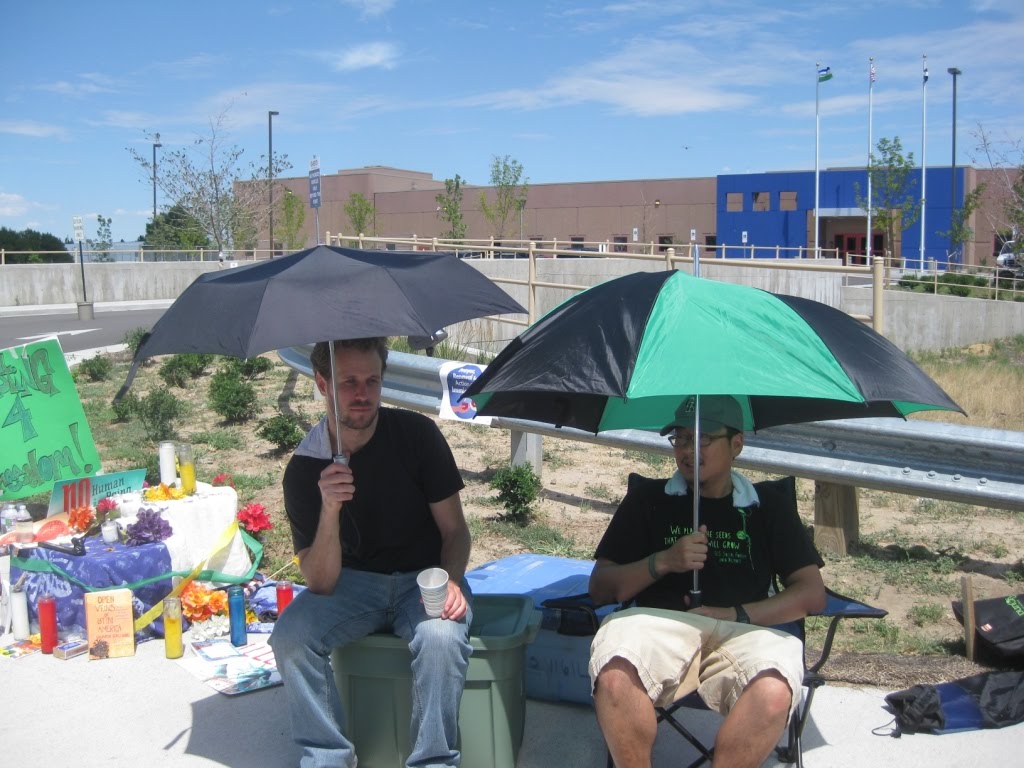

We’re here to end our time of physical vigil and fast in solidarity with those inside this detention center, knowing that we will continue to hold constant vigil in our hearts until no person is detained here.
May we have the perseverance to continue to strive for a community where no one is detained or separated from those they love, and where the humanity of all is reclaimed.
We’re here because workers – those who contribute to the creative fabric of our community, those who build the infrastructure of our society, and those who contribute their strength to making this world a more livable place for all – are imprisoned here.
May we continue to contribute our creativity, work, and strength to making this a community where everyone’s labor is valued and honored.
We’re here to honor and remember the fathers, mothers, sons, daughters, partners, neighbors, and friends detained here. We stand in resistance today of initiatives that rip our families and neighborhoods apart.
May we honor all of the relationships in our lives that sustain us, nurture us, and support us in creating a better world.
We’re here because we believe that our community can be something different and something better than this broken system of detainment has to offer us. We’re here because we vision a world where borders, barbed-wire, and fences do not control our human relationships.
May we consider the ways we perpetuate a spirit of detainment and control in our lives and strive to dismantle the spirit of enforcement everywhere in our world.
We’re here because we are thankful – for the earth’s ability to produce food for us, for the hands that sow seeds and harvest produce, for the people who transport food to our local area, and for all those whose hands have touched this bread along the way.
May we honor them in the way we share and eat this meal and remember the ways every action we do affects many others in our world.
We will now break bread together in order to break our fast as a symbol of the ways we nourish each other, the goal of sharing community together, and the desire for every member of our community to be offered a place at the same table of fellowship.
As you receive the bread, please find someone who you do not know, or don’t know very well, exchange names with them, and then offer them bread saying:
“With this bread I offer you nourishment, acceptance, and love as a member of my community.”
Thursday, July 22, 2010
InterMountain Yearly Meeting Minute on Recent Immigration Legislation and Comprehensive Immigration Reform
June 2010
As a faith community committed to welcoming the stranger, we are dismayed and saddened by the failure to find a way forward to craft an immigration system that respects the fundamental rights and dignity of all. We recognize that inaction at the national level has created a vacuum into which states have stepped to create their own immigration laws.
As Friends, we believe that there is that of God in everyone, regardless of citizenship or legal status. Our testimony of community challenges us to live with all of our neighbors in a way that encourages trust, love, and security. Our testimony of equality leads us to value each person as an individual and to respect the human rights and dignity of all persons. Our testimony of peace guides us to take nonviolent action to resolve conflicts in a way that brings us together and promotes justice.
Arizona Senate Bill 1070 and similar proposed legislation in other states divides our communities and criminalizes immigrants. These kinds of unjust laws create a climate of fear for those whose area of residence, line of work, complexion, spoken language or accent is deemed suspicious, even if they are citizens or legal foreign residents or visitors. When state legislation is passed that compels people to hide their identity from authorities, they must live in fear that they will be separated from their families, that they will become victims of crime, that they and their children will not receive an education, and that they will lose their livelihoods and their homes.
We bear witness to our friends and neighbors in our community who suffer division of their families, exploitation in the workplace, and the daily fear of deportation. We bear witness to the thousands of deaths on the border and the destruction of border communities and the environment. The estimated twelve million persons living and working in the United States without papers are essential parts of our communities and economy, yet the system for regularizing their status is woefully insufficient. Criminalizing immigrants and those who care for them, as in Arizona Senate Bill 1070, does not address the real challenges our country faces with immigration reform and resolution of the humanitarian crisis that results from the broken system.
We, as people of faith, are called not only to resist unjust laws and to work to change them, but to take the initiative to act in accordance with higher laws. We call upon Friends everywhere to urge our elected representatives to immediate action on humane immigration reform. We call upon ourselves to act with integrity in response to these challenges and we rededicate ourselves to loving our neighbors, to doing justice, and to walking humbly in the spirit of love.
(Please see http://www.imym.org/ for more information.)
Tuesday, July 13, 2010
Fasting 'Cause We're Hungry for Justice!
Join us 5:00 – 7:00 PM, TONIGHT Tuesday, July 13th, 2010!
Fasting 'Cause We're Hungry for Justice!
... and activities for Non Fasters, too!
At the end of this month, we’ll be hosting at 3 Day Fast for Immigrant Justice. We’re excited to have you over, talk about the details and really discuss what a meaningful and perhaps transformational experience around fasting can look like. It might look different for everyone, and we’re interested in all of them. We’ll talk about being healthy as we fast, taking time to think about where our food comes from and explore a little bit of the history around fasting. We’ll share and swap ideas for how to make this fasting experience unique and compelling. Whether you join us for the breaking of the fast on August 2nd or you fast for the whole week, we are committed to having a shared experience that is unforgettable.
Meet us at the AFSC office, 901 W. 14th Ave, Suite #7, Denver, CO, for some SNACKS and a skill share, learn how further support the human rights of immigrants!
Solidarity for a Different Future!
No more detentions! No more deportations! No more oppressive laws!
24-hour fast, community visioning & vigil
'Cause We're Hungry for Justice!
Join us, in solidarity with the people of Arizona and those unjustly detained in our own state, for
24 hours of fasting, reflection, workshops, prayer and protest.
Beginning: Sunday, August 1st at 6:00pm
30th & Peoria, Aurora, CO
We'll set up camp overnight outside the GEO Immigrant Detention
Center, making our presence known to our community on the other side of the walls.
The following 24 hours we'll have ongoing educational opportunities, time for deeper reflection on solidarity
and visioning of the world we will create.
And always time for healing song, prayer and protest!
Join us for all or part, whether or not you choose to fast!
Breaking of the Fast: Monday, August 2nd at 6:00pm
30th & Peoria, Aurora, CO
We'll break our fast together in front of the GEO Immigrant Detention Center.
On July 29th, Arizona's anti-immigrant law SB 1070 is set to go into
effect. For the week of July 25th-August 2nd communities around the
country will be fasting to declare their opposition to oppressive laws
like SB 1070, laws which separate families and terrorize workers,
neighbors and friends who are caught in a broken system. You can join
in showing that it is Justice for which we hunger, not greater
repression nor a continued status quo which denies immigrants their
human rights.
Ways to participate:
• Join us for part or all of the 24-hour solidarity vigil and fast outside the detention
center and come to the breaking of the fast the next day.
• Sign up to fast for the entire week, 3 days or 24 hours Send your name and commitment to jpiper@afsc.org .
• Support the 24 hour vigil and fast: offer workshops, testimony, songs or prayer
during the 24 hours at the detention center.
• Offer to bring food for the breaking of the fast.
* In spite of the absolute safety and benefits of fasting, there are
certain persons who should NEVER fast without professional
supervision. For example:
• Persons who are physically too thin or emaciated.
• Those who suffer weakness or anemia.
• Persons who have tumors, bleeding ulcers, cancer, blood diseases, or
who have heart disease.
• Persons who are prone to anorexia or bulimia
• Those who suffer chronic problems with kidneys, liver, lungs, heart,
or other important organs.
• Individuals who take insulin for diabetes, or suffer any other blood
sugar problem such as hyperglycemia.
• Women who are pregnant or nursing.
There are plenty of ways to engage in meaningful time for reflection if fasting isn’t a good fit for you.
Thursday, June 17, 2010
"Our visions begin with our desires." Audre Lorde...
In 2004, my parents and my two little siblings were detained in California. I was left behind, here in Colorado. I remembered that it was summer time, hot like today. I recalled my mother's sad, muffled, yet thinly hopeful voice on the telephone. Our conversations were clipped by tears and sobs. I recalled this very sharp, eery sensation in my stomach every time I got the phone call. Every time I begun hearing her voice. Only her voice.
All the missing parts, combined with the uncertainty were the most painful.
I thought of my mom, my little brother and my little sister not knowing where exactly my dad was. They were separated from the beginning. I never heard from my dad during that time, because he used his phone card only to call the attorney. My mom tried to assuage me by saying that he was in a nice facility where he could go out to the yard, read magazines and watched TV.
On the contrary, my mom and my siblings were in the shitty center in LA, where during day they only eat the same cafeteria hamburgers, where they had to sit inside a communal jail cell for ten hours to watch the corner TV and to watch other detainees coming and going. They were not even allowed to get out to the yard. If there was one. She tried to reassure me that at night they get to sleep in a comfy room at motel six, where they had nicer beds than they had at home, where they had cable TV and the freedom to choose the TV channel, all while being supervised inside their room by two rotating armed guards.
During one of the phone calls, I told her how i missed her cooking so much and how i was tired of the ramen noodles and eggs for dinner each night. Ironically that was what they'd been having for dinner also. She told me how frustrating it was not knowing how to get a hold of my dad. But then she said she was lucky that she at least had my little siblings to cuddle with, whereas my dad had no one. I asked how my brother and sister were doing, and she answered me with this respond that was soon to be my crystallizing image for the entire experience. She said that they were playing cards with the armed guards. A game of go-fish, she said.
I was struck by the absurdity of this image. Two kids, age 10 and 13, sitting around a small table playing card games with the guards who were in charge of detaining them. I don't know if they set bets before hand, and my little siblings happened to place a wager for their release. Surprisingly, they won. Well, they were lucky. They were detained for two months, then...released.
But our luck took us only so far. As soon as my parents were released, they had to work overtime. Yet they had their wages garnished because they were in debt to the their employers for bailing them out and for paying the attorney fees. Then the economic crisis cut down their work hours so much they could no longer afford the mortgage payment. We soon lost our house.
But still, we were the few lucky ones. What about the unlucky ones?
What about those who are completely alone? who came here without anybody, knowing nobody, whose bodies were only valued by low wages and abused by hard labor, who are now being systematically lined up in front of aloof bureaucrats and waiting to be so easily tossed back, tossed away?
What about the parents who didn't get to see their children when they were captured, let alone cuddled with them? those who only heard their children's tears as their last frozen memories?
What about lovers who only got to see each other through glass walls? Only hearing each other's distorted voices, and see the lips that can't be kissed, the hairs that can't be felt. Those who could only smell the emptiness of cold air that robbed them from a loved one's familiar scents, those whose most sensible goodbyes are forced by unjust laws, set within tough walls and lit by harsh florescent lights...
What about the trans lovers and the same gender lovin' lovers, who not only were told that they were in a wrong country, that they were on the wrong side of the border, speaking the wrong language, eating the wrong the foods, but also, were told that they were loving the wrong bodies, loving the wrong sex?
I guess it is unlucky to be gay in such a homophobic world
it is unlucky to be a migrant in a xenophobic world
it is unlucky to be black, or brown, in a white man's world
just as it is unlucky to be poor in a rich man's world
But who deals these unlucky cards we get? Who sets the rules of the game? If we're losing, then who's winning? who is collecting our bets?
Our bodies should not be bargaining chips to be wagered against, neither should be our sweat, nor our loves...
However many unfortunate losses we've had...those we must keep near. Our deferred dreams, our unfair debts, our wasted sweats, our abused and tired legs, our lost embrace, our abrupt partings... those we must collect in a tank until the pressures of life squeeze them so hard that oil comes out, or rather something like volatile desires.


 Posts
Posts


