By ALEJANDRA JUAREZ
"When that [DREAM Act] passes, millions of children will be able to get the education they need to contribute to our economy," stated Sen. Harry Reid (D-NV) during his press conference announcing that he would include the DREAM Act in the Defense Authorization Bill on September 21. Almost immediately, Republican leaders came out against the move in spite of the commonly held belief that the DREAM Act is bipartisan legislation. "I intend to block it, unless they agree to remove the onerous provisions," said Sen. John McCain (R-AZ).
While Republicans are accusing Democrats of playing partisan politics in an effort to maintain their footing this coming November, mobilizations have been taking place across the nation for months now in an attempt to get Congress and the Obama administration to pass Comprehensive Immigration Reform (CIR). Immigrant youth, especially, have trekked across state lines, protested in congresspersons' offices, and flooded Congress with letters urging them to pass the DREAM Act. Called DREAMers, they have come out and risked being deported in the hope of gaining legal status.
What is the DREAM Act?
The Development, Relief and Education for Alien Minors (DREAM) Act has been floating in Congress for nearly a decade now, first introduced in 2001 as H.R. 1918 and S. 1291 in the House and Senate respectively. In 2007 Sen. Richard Durbin (D-IL) filed to place the DREAM Act as an amendment to the 2008 Department of Defense Authorization Bill (S. 2919), but it failed to pass. A last-ditch effort was made later that year by introducing the DREAM Act as a stand alone bill, nevertheless, the 60 votes required to avoid a filibuster were not there.
The version now being included as an amendment to the Defense Authorization Bill by Sen. Reid was introduced in March of 2009 by senators Durbin (D-IL), Lugar (R-IN), Reid (D- NV), Martinez (R-FL), Leahy (D-VT), Lieberman (I-CT), Kennedy (D-MA), and Feingold (D-WI).
If passed, the DREAM Act of 2009 would give young undocumented immigrants from any country of origin who are under 35 years old and who arrived in the United States before age 16 the opportunity to gain legal status by either attending college or joining the military. However, only those who have obtained a high school diploma or GED and have not left the United States in the last five years are eligible to gain conditional Legal Permanent Residency (LPR).
Once eligibility has been ascertained, LPR status would be granted on a conditional basis and valid for six years, during which time the student would be allowed to work, go to school, or join the military. After six years, if the person has shown good moral character and either completed a minimum of two years of higher education toward a bachelor's degree or higher, or served in the military for two years, the conditional status would be removed and full LPR would be granted.
With any chance of passing CIR now declared dead by many Democratic leaders, including President Obama, we are being told the DREAM Act is Plan B , the only viable proposal for addressing the immigration issue. Just last week Univision's Jorge Ramos proclaimed that there will be no legalization for the 11 million undocumented this year. Nor, perhaps, next year -- nor the next. Senator Reid, himself, said, "I know we can't do comprehensive immigration reform -- I've tried to. I've tried so very, very hard."
A Rift Has Developed
But although the DREAM Act has unconditional supporters in the Congressional Hispanic Caucus (CHC) and other Latino organizations like the League of United Latin American Citizens (LULAC) and the National Council of La Raza (NCLR), in particular, a rift has begun to appear within the movement that has emerged around the DREAM Act.
Community groups like San Diego's Committee Opposed to Militarism and the Draft (COMD) has opposed the armed forces provision of the DREAM Act for years. More recently, even the young activists who have participated in acts of civil disobedience across the country have not only questioned the military component but the way in which the Democrats are contributing to the argument that the parents are criminals who broke the law by crossing the border illegally in an attempt to provide a better life for their children. "They are vilifying and criminalizing our parents and [arguing] that undocumented students shouldn't pay for the sins or illegal behavior of their parents," wrote Raul Al-qaraz Ochoa, one of the protesters arrested at Sen. McCain's office in Arizona this summer.
Still, the majority in the movement uncritically supports the DREAM Act because they believe its passage will benefit millions of young undocumented immigrants while also serving as a stepping stone for CIR down the road. If we examine the legislation closely, however, some issues arise with these arguments.
First, the simple fact that Democrats are attaching the DREAM Act to the defense bill speaks to its militaristic orientation; the DREAM Act forms part of the Department of Defense's FY2010-12 Strategic Plan to help the military shape and maintain a mission-ready All Volunteer Force.
According to UC San Diego professor Jorge Mariscal, the DREAM Act was largely developed by the Pentagon. One need only read Senator Durbin's testimony. It was not about education. It was strictly about making a pool of young, bilingual, U.S.-educated, high-achieving students available to the recruiters.
This is further evidenced in the 2009 policy report "Essential to the Fight: Immigrants in the Military Eight Years After 9/11," authored by Margaret D. Stock, retired Lieutenant Colonel in the U.S. Army Reserve. In it she writes, "Despite the important contributions of immigrants to the military in the ongoing conflicts, one proposal that would allow more immigrants to serve in the armed forces [DREAM Act] has made little headway in the past eight years. ... Because attending college is a very expensive proposition, ... joining the armed forces is a likely choice for many of the young people who would be affected by the bill (p. 8).
Stock concludes, "Without them, the military could not meet its recruiting goals and could not fill the need for foreign-language translators, interpreters, and cultural experts. Given the unique and valuable functions that immigrants often perform in the military, they are a critical asset to the national defense. Immigrants have been and continue to be essential to the fight" (p. 11).
At the same time, by attempting to pass the DREAM Act before the November mid-term elections, Democrats seek to rally support from Latinos who comprise the largest sector of the immigrant community and who are a key voting bloc for the Democratic Party.
It was this voting bloc that handed Obama the presidency in 2008, based largely on the promise that he would deliver CIR during his first year in office. Having failed to do so -- and, on the contrary, having increased the repression on the undocumented community through raids, employer sanctions, and the militarization of the border -- more and more Latinos have grown increasingly discontented with the Democratic leadership.
It is difficult to imagine a Democratic victory in Congress without the Latino vote. The Democrats know this and are offering the DREAM Act as appeasement, claiming there is no political will to pass CIR. Yet, it took no effort to pass the $600 million border militarization bill this past August.
Other Objections
Second, according to Sen. Reid and other proponents, passage of the DREAM Act would benefit millions of undocumented immigrants. Although it is difficult to know the exact number of undocumented youth in the United States, the Migration Policy Institute's 2010 study "Dream vs. Reality: An Analysis of Potential DREAM Act Beneficiaries" claims that there are approximately 2.1 million who could potentially be eligible.
However, not all would qualify for LPR status. Only an estimated 825,000, or 38%, would be able to gain full LPR. For those undocumented youths who do not meet the requirements after the six years of conditional status there is no guaranteed that they would not be deported. The legislation also authorizes the Department of Homeland Security (DHS) to share information with other law enforcement agencies.
Third, the choice of attending an institution of higher learning, as opposed to joining the military, in order to qualify for LPR is only feasible for a small number of undocumented youth. For example, Latinos in general, compared to other ethnic groups have the lowest number of college attendees -- only 1.9%, compared to 3% for Blacks, 3.8% for whites, and 8.8% for Asians. The national high school drop-out rate among Latinos is around 40%. In California the drop-out rate is 36%.
Moreover, a significant percentage of the 1.5 generation coming to the United States without papers arrive with very little schooling and come to work to contribute to the family income. These undocumented youth would not even qualify for conditional LPR status.
The college option of the DREAM Act must also be looked at within the new higher education framework where the cost of attending college becomes another barrier. Throughout the country -- and in California especially -- the tuition or university fees at public universities have skyrocketed ... a whopping 32% increase at the UCs and CSUs last year and 54% at community colleges; not to mention the cap enrollments and repeal of affirmative action also affecting ethnic minorities.
Under the DREAM Act students would not be eligible for federal financial aid -- only loans and work study. Moreover, the DREAM Act gives states the prerogative to decide if these students qualify for in-state tuition (repealing Section 505 of the Illegal Immigration Reform and Immigrant Responsibility Act of 1996).
De-Facto Choice to Gain LPR Status
The military option then becomes the de-facto choice to gain LPR status for most undocumented youth. There are already non-citizens in the armed service who are seeking citizenship for themselves and their loved ones through fast track established by former President Bush in 2002 as part of the War on Terror.
However, as Professor Mariscal points out, the promise of a green card is not always assured. Military service does not guarantee citizenship and tragically for those who have given the ultimate sacrifice, posthumous citizenship [is] a purely symbolic gesture with no rights or privileges accruing to the deceased person's family.
With the continued occupations in the Middle East and elsewhere, as well as the increased militarization of the U.S.-Mexico border, it is very likely that those joining the military under the DREAM Act will see combat. And although the DREAM Act asks for only two years of military service, we must be aware that there is no such thing as a two-year military contract. In 2003 Congress passed the National Call to Service Plan as part of the Military Appropriations Act. This mandated that all of the services must create an enlistment program offering a two-year active duty enlistment option, followed by four years in the Active Guard/Reserves, followed by two years in the Inactive Reserves. This is a total of eight years.
If that were not enough, low-income and youth of color tend to see most of the direct combat. Professor Mariscal writes, "Latinos and Latinas are bunched together in the private and corporal ranks (or lowest ranks) and therefore are among the most likely to receive hazardous duty assignments. ... [In 2001 they] made up 17.7% of the Infantry, Gun Crews, and Seamanship occupations in all the service branches. Of those Latinos and Latinas in the Army, 24.7% occupy such jobs and in the Marine Corps, 19.7%.
It is important to remember that Latinos make up only 13.5% of the general population. In contrast, in the elite and most highly romanticized military special operations units such as the Navy Seals, people of color are virtually non-existent given the stricter educational admissions criteria.
For a DREAM Act With No Military Strings Attached!
The DREAMers and the movement they have built together with their allies have fueled the immigrant rights movement in spite of other setbacks like SB 1070. Undocumented youth are tired of the vast inequities and limited opportunities afforded to them because of their citizenship status.
Although the DREAM Act would only benefit a small number of undocumented immigrant youth, what the DREAMers are fighting for -- the right to education for all, the right to have a job that helps our families get out of poverty, the right to live without fear of incarceration and deportation, the right to keep families together -- is the right thing.
All of us in the immigrant rights movement and our allies should applaud and support their cause and denounce the Democrats for attempting to usurp the struggle. We should not be asked to assist in the continued occupations of Iraq and Afghanistan, or in any new militaristic adventures in Latin America, Iran, or elsewhere in order to obtain papers for our immigrant brothers and sisters. Nor should we have to subjugate those who look like us in foreign lands or on the border.
We in the immigrant community are not discouraged by the lack of political will in Washington. We will continue to fight for a new and just immigration policy based on human and workers' rights.
More than ever, it is necessary to (re)build an independent mass movement for legalization. It will take huge mobilizations and strikes like those that took place in the spring of 2006 to force the ruling elite to grant our just demands.
We must champion the DREAMers movement -- that is, a real DREAM Act without any militaristic strings attached -- while also calling for:
- No to the militarization of the border; tear down the Wall of Shame!
- Stop the raids and deportations!
- No to the E-Verify Law and to the criminalization of immigrant workers!
- No to Guest Worker Programs!
- No to the separation of immigrant families!
- Repeal the "Free Trade" and Military pacts in Latin America (including the dismantling of all U.S. military bases in the region)!
As immigrant rights activist Raul Al-qaraz Ochoa aptly wrote, "Strong movements that achieve greater victories are those that stand in solidarity with all oppressed people of the world."
EL ORGANIZADOR
P.O. Box 40009
San Francisco, CA 94140
Tel. 415-641-8616
Email: elorganizador@earthlink.net
Tuesday, September 21, 2010
Behind the Latest Version of the DREAM Act: Is This Legislation We Should Support?


Letter to the DREAM Movement: My Painful Withdrawal of Support for the DREAM Act
Septiembre 18, 2010
by Raúl Al-qaraz Ochoa
I have supported the DREAM Act, despite my critiques and concerns over the military service component. In fact, I was one of the arrestees at the sit-in at John McCain's office in Tucson, AZ; an act of civil disobedience where four brave undocumented students risked deportation and put the DREAM Movement back in the national political stage. I made peace with my participation because I felt I was supporting the self-determination of a movement led by undocumented youth and I felt we could subvert the component that was to feed undocumented youth into the military pipeline if we developed a plan to support youth to the college pathway.
First, let me say that I applaud and admire the tireless work you have all done for the past 10 years. Your commitment and dedication parallels giant student movements of the Civil Rights era. Your persistence in organizing even when the world turned their back on you is inspiring; your creativity in tactics, visuals and media strategy is amazing. Your movement gives hope to hundreds of students I have come across here in Arizona and beyond. It is because of your grassroots efforts-not the politicians' nor the national Hispanic organizations'-that the Dream is still alive and has come this far. As an organizer with permanent resident status privilege, let me assert that your cause for access to college and path to legalization is just. No one can tell you that what you are fighting for is wrong.
With that said, I want to share how I am deeply appalled and outraged at how Washington politics are manipulating and co-opting the dream. I understand that some folks may say, "we just want the DREAM Act to pass regardless", but it is critical to examine the political context surrounding DREAM in its current state. It is disturbing to see how Democrats are attaching our community's dreams for education/legalization to a defense appropriations bill. This is grotesque in a number of ways:
1) Democrats are using the DREAM Act as a political stunt to appeal to Latino voters for the November elections because it is seen as "less" threatening than a broad immigration reform. The Democrats have the political will to recently unite and pass a border militarization bill in a matter of hours ($600 million!), yet they won't pass a broader immigration reform? And now they are up for the DREAM Act? I'm glad they feel the pressure of the Latino voting bloc, but they obviously do not care about our lives, they only seek to secure their seats in November-which by the way look very jeopardized if they don't move quickly to energize their "base". They are also seeking to secure the gay vote with the gradual repeal of the "Don't Ask, Don't Tell" policy as part of this same defense bill. All in all, insincere, token political gestures only serve to stall real justice.
2) Democrats are telling me that if I support access to education for all my people, I must also support the U.S. war machine with $670 billion for the Pentagon? Does this mean I have to support the military occupation of Iraq and Afghanistan? By supporting the DREAM Act, does this mean I automatically give a green light for U.S. forces to continue invading, killing and raping innocent people all over the world? This is really unfair. Here in Arizona I struggle with a climate of fear and terror. Yet even though I am so far away, I hear the cries of Arab mothers who are losing their children in U.S. sponsored bombings and massacres. There's a knot in my throat because victims of U.S. aggression abroad look just like usŠ victims of U.S. aggression at home. This ugly and twisted political system is dividing us and coercing us into supporting the funding of more bloodshed and more destruction if we want the DREAM Act to pass. Does this mean that our dreams will rest upon the nightmares of people that suffer globally? Obviously, students that call their Senators are supporting their future NOT bloodshed abroad, but we have to be responsible to the larger political implications of this.
3) Democrats are vilifying and criminalizing our parents. A really insulting argument prominently used for passing the DREAM Act that I keep hearing over and over is that because undocumented students "didn't choose to come to the U.S. to break the laws of this country" you shouldn't have to pay for the "sins" or "illegal behavior" of your parents. Are they serious?!? It is not okay to allow legislation to pass that will stand on and disrespect the struggle, sacrifice and dignity of our parents. What about blaming U.S. led capitalist and imperialist policies as the reasons that create our "refugee" populations. Our parents' struggle is not for sale. We must not fall for or feed into the rhetoric that criminalizes us or our parents. We all want justice, but is it true justice if we have to sell out our own family members along the way?
Again, I support this fight-it's part of a larger community struggle. It's personal to all of us. Passage of the DREAM Act would definitely be a step forward in the struggle for Migrant Justice. Yet the politicians in Washington have hijacked this struggle from its original essence and turned dreams into ugly political nightmares. I refuse to be a part of anything that turns us into political pawns of dirty Washington politics. I want my people to be "legalized" but at what cost? We all want it bad. I hear it. I've lived it. but I think it's a matter of how much we're willing to compromise in order to win victories or crumbs.
This again proves how it is problematic to lobby the state and put all our efforts in legislation to pass. We should know that this political route is always filled with racism, opportunism, betrayals and nightmares. History repeats itself once again.
So if I support the DREAM Act, does this mean I am okay with our people being used as political pawns? Does this mean that my hands will be smeared with the same bloodshed the U.S. spills all over the world? Does this mean I am okay with blaming my mother and my father for migrating "illegally" to the U.S.? Am I willing to surrender to all that in exchange for a benefit? Maybe it's easier for me to say that "I can" because I have papers, right? I'd like to think that it's because my political principles will not allow me to do so, regardless of my citizenship status or personal benefit at stake. Strong movements that achieve greater victories are those that stand in solidarity with all oppressed people of the world and never gain access to rights at the expense of other oppressed groups.
I have come to a deeply painful decision: I can no longer in good political conscience support the DREAM Act because the essence of a beautiful dream has been detained by a colonial nightmare seeking to fund and fuel the U.S. empire machine.
I am so sorry and so enraged that this larger political context has deferred those dreams of justice and equality that we all share.
In tears, rage, love and sorrow,
-r
http://antifronteras.com/2010/09/18/letter-to-the-dream-movement-my-painful-withdrawal-of-support-for-the-dream-act/
Friday, September 17, 2010
AFSC & CFIR Film Screening: Borders Lifted, Voices Raised || THIS SATURDAY 3PM!
Hope you can Join us the Saturday at 3 PM at the Starz!
“Ten stories by 6 immigrants and 4 allies from Denver combine narration, original art, music and images to share their experiences with immigration and creating community”
DATE: Saturday September 18th at 3:00 pm
LOCATION: Starz FilmCenter :: 900 Auraria Parkway, Denver, CO 80204
ADMISSION: $9.75
50% of the proceeds will benefit to AFSC
“Borders Lifted, Voices Raised” on
Purchase tickets 3 ways:
1. Buy it online here: http://www.denverfilm.org/filmcenter/detail.aspx?id=23411
2. Pay at the door
QUESTIONS + INFO: T: 303-623-3464 ext.3 E: jgarcia@afsc.org W: http://coloradansforimmigrantrights.blogspot.com
Special Thanks: Center for Digital Story Telling
Friday, August 27, 2010
Papaturro, El Salvador, 10 August 2010
Dear Family and Friends:
A week ago Monday I got up at 4:45 am to catch the 5:10 am bus (one of three buses daily that makes it down to Papaturro). Destination: Suchitoto for our Annual Evaluation of our Microlending Projects. The 20-minute ride up to the main road was routine, making it easy to daydream as I looked out the window bouncing along the sometime cobblestone road with short stretches of cement (the rest of the time: dirt, mud, and one-foot deep ruts), the dawn breaking on the eastern horizon—cloud-capped mountains and long-dormant volcanoes in the distance, and corn fields for miles around. El Salvador makes me a morning person (not my normal state in the US), one of her many gifts to me.
The morning bus ride ended up being the first and last thing that was normal about this day. We got to the main road to find out that there was a transportation strike on the route that runs from the capital of San Salvador to the colonial pueblo of Suchitoto where we were headed. Not exactly music to my ears in light of the fact that we were planning to bring together 100 women for our annual evaluation in two hours. So, I got on my pre-paid Salvadoran cell phone and started calling around. There were other people waiting up the road, including one of the project coordinators. We made a couple more calls and found out that the buses were running from the western part of the province, and that (hopefully) the only folks stranded were our three groups out on the eastern highway. Our only option was to get one of the drivers from Papaturro to round up the women who were attending from our community and come in his truck and pick up all of us waiting on the highway. Twenty minutes later it was all set up, and a half hour after that, we were on our way to town!
Amazingly, 90 women made it to the meeting, transportation strike and all. And we had a very fruitful morning of reflection and sharing on this important work of empowerment of women. In the words of Candelaria, one of the project coordinators, “These funds are not a donation, they are a tool for organization. We must claim each project as our own and make it work for our community, providing women with the opportunity for economic independence AND strengthening the organization of women throughout our zone. Through Project Salvador we are becoming creators of our own future.” From our humble beginnings in 2003 with a $1000 donation that I brought to the Women’s Committee in Papaturro, we now have microlending funds in 19 communities in north central El Salvador, available to 2400 families. In the past six years over 600 women have received almost 1300 loans of $50-$300. And our board decided this year to expand to five more, bringing the total number of communities to twenty-four. It is quite inspiring!
Juxtapose the euphoria of this day, with the reality that the transportation strike was in response to the latest extortion demand of one of the Salvadoran gangs who are charging monthly payments from the bus owners. The co-op of buses that do the San Salvador-Suchitoto Route 129 were paying $300 per month. They were told by the gang leaders that they had to start paying twice that amount. The Coop board met and decided to call the transportation strike in protest! A very bold move, likely to result in more than one death--the way the gangs pressure businesspeople into paying up is by killing those who don’t. My ride back home on the back of the truck was tempered by this sobering reality, as we watched the streets emptied of the primary source of transportation for the poor majority in El Salvador.
A driver on a different route was actually killed the morning of the strike, for not paying the fee. The death toll for the year just in the transportation sector was already at 71 when I was here earlier in May. It is likely well over 100 by now. The Route 129 drivers were to be spared this time, as the Coop board paid the $600 extortion fee and the buses were up and running again the next day.
My time in El Salvador is full of these kinds of dichotomies: the artisans we work with continue to seek ways to earn a just wage, as they have been for 20 years now with Project Salvador; the youth ecology committee in Papaturro is organically developing a community-wide social consciousness around the environment, appropriate technology and conservation—with resounding success; the Project Salvador board has decided to walk with Sr. Isabel in metro San Salvador supporting her dreams of a youth center to address the gang violence in the parish of Plan del Pino; and the PICO Central America leaders from El Salvador and now Guatemala are seeing the results of effective community organizing as they celebrate the significant gains in creating a public dialogue around community safety in this violence-ridden land. I am deeply blessed and privileged to witness all this work firsthand and I could go on for a long time, telling stories of ordinary (“marginalized, poor, uneducated”) people doing extraordinary things. I am constantly learning, and in awe.
Meanwhile, at a national level, things are grim. Much like the rest of the world, the economy here has gone completely down the tubes. Most things cost as much here as in the states—food items, clothing, shoes. Rent is somewhat cheaper, gasoline is more expensive, medical care is pretty low-cost if you are willing to wait, but medicines are not easy to come by in the public health care system and not cheap in the provate sector. The minimum wage here is about $200 per month in the city and less than $150 in rural areas. Unemployment is 30%, underemployment another 30-40% (unless you can call selling candies or fruit or pupusas or hair accessories on the bus a real job.) Most of the people I know are subsistence farmers. They would keel over and think they had gone to heaven if they saw $150 a month. A struggling economy, rampant gang violence, surely it is not a wonder that Salvadorans, especially the youth, continue to head to the States. The going rate now is $7000 for a long (15- to 30-day) exhausting, dangerous trip al norte.
I was blessed during a morning of visits to microlending projects to learn Candelaria’s story. It came out slowly; as I drove, she spoke: A victim of sexual abuse at a young age, she left her mother’s home when she was nine to escape the abuse. She remembers sitting out in the cold, by the side of the cowpath that lead to her now-abandoned home, ready to kill herself by taking rat poison (she had heard on the radio that someone had killed himself that way); her brother, who had followed her when she snuck out of the house, talked her out of it. (Her eyes welled with tears as she recounted his own suicide a few years later, by the same means, with no one there to help him see the value in living as he had for her.) She ended up being taken in by her older sister where she was again victimized. She fled at 17 by moving in with her boyfriend and was a mother within a year. Now, at 25, she and her partner have both gone through a transformation, as she has come to understand her power as a woman, to name and stop the abuse, to believe in herself and her capacity to shape her own future. Much of this has come about because of her involvement with women’s organizing in her community and now at a regional level as a young leader. Her partner has benefited from similar work with men that looks at oppression and machismo and how to relate to women—in public and in personal relationships— in a way that is mutually respectful and empowering. Candelaria would like to continue her education (she finished high school a few years ago) and be able to model for her daughter the endless possibilities that exist for women in El Salvador today. I believe she will!
There are the comical/dramatic moments as well—The winner this year was definitely the ride home on the back of the 8-ton farming truck with 3 newly acquired cows, one of whom decided to pee and then poo right next to one of our visitors, Michelle, who had “won” a week-stay at our house at a silent auction fundraiser in Denver. She was not a happy camper to say the least. Driving a truck over the washed out bridge at Agua Caliente was a close second, and then making it up an incline that was clearly not ever meant to be a road (Marleni reminded me after we arrived that last year the driver had left the car down at the main road…); we somehow made it to our meeting with the microlending group in Pepeishtenango, and back to Suchitoto, gracias a dios.
And there’s been plenty of play time, too: With two sets of visitors here (all silent auction winners!), I got to do two more tours through the Mayan ruins at Joya de Ceren and I am as in love with them as ever. Buried under volcanic ash over 1500 years ago, they are the only ruins in Mesoamerica of peasant dwellings-a unique window into the daily life of the native people who farmed this land so long ago; they are now on the not-to-be-missed list for visitors here. Wish I had discovered them sooner, but sie la vie.
Tom was here for ten days, and fit right in to life in the campo. We spent our first three days in the eastern part of the country seeing firsthand the flood recovery efforts in Tierra Blanca where my dear friend Elena Jaramillo has lived since 1988. We spent the rest of the time in Papaturro, which gave me a chance to relax in my hammock, catch up with friends and enjoy our incredible garden—including a new (volunteer) papaya tree by the compost pile and zinnias galore (thanks to my daughter Silvia)—which means the butterflies are back in full force—beautiful beyond words.
My two-and-a-half-year-old grandson Angelito was here for most of the month of May as my daughter, Susana & son-in-law, Neris, and I played tag team so we could all spend time with 88-year-old Teresa, my kids’ Salvadoran grandmother, who fell at the end of April and broke her leg at the hip. She is recovering as well as could be expected and we are hopeful she will walk again someday. Meanwhile, Angelito is very comfortable in Papaturro. He enjoys all the animals, the freedom to run and play, being with all his friends and relatives—especially his grandparents, aunt Silvia and cousin Tatiana. It is truly a gift to be able to share this life with him, and all my grandkids—number seven, Anthony Rodrigo, is due in November (to Tony and Isabel)!
Silvia got her nose pierced (the first in Papaturro!), her daughter Tatiana lost both her front teeth this summer, Lidia and Regina each had a baby, we did two HARD jigsaw puzzles this year (we usually just do one), made it to the Children’s Museum, the bookstore at the Jesuit University and the Shicali ceramics co-op (providing dignified employment to disabled people in San Salvador), saw two movies and had lunch at Pizza Hut (three times!), did an overnight excursion to the beach— jumping to our heart’s content in the warm Salvadoran surf, and I read five books— The Life of Pi, Three Cups of Tea, Isabel Allende, Ursula Hegli and Tony Hillerman—yes, some parts of life are universal, wherever you are.
I found countless images running through my mind this year as I traipsed through the countryside—all the years I have been coming to El Salvador, the hundreds of stories I have heard, the people I have known, the experiences that marked me and my children’s lives forever. I wish I had the time to start to write it all down. Could be an interesting tale…Maybe during my sabbatical in 2011!?!
My time here is drawing quickly to a close. I leave on Sunday, August 15, a quick 3-day stop in Denver, and then I am off with Tom for a 9-day trip up to southwestern Idaho for five days of rafting on the Lower Salmon River. My summer break ends on August 29 and then it’s back to reality? Or is it? Something to ponder.
Off this goes, then, into the cyber waves, with warmest greetings to each of you and blessings always, patty
Tuesday, August 3, 2010
Breaking of the Fast Ritual


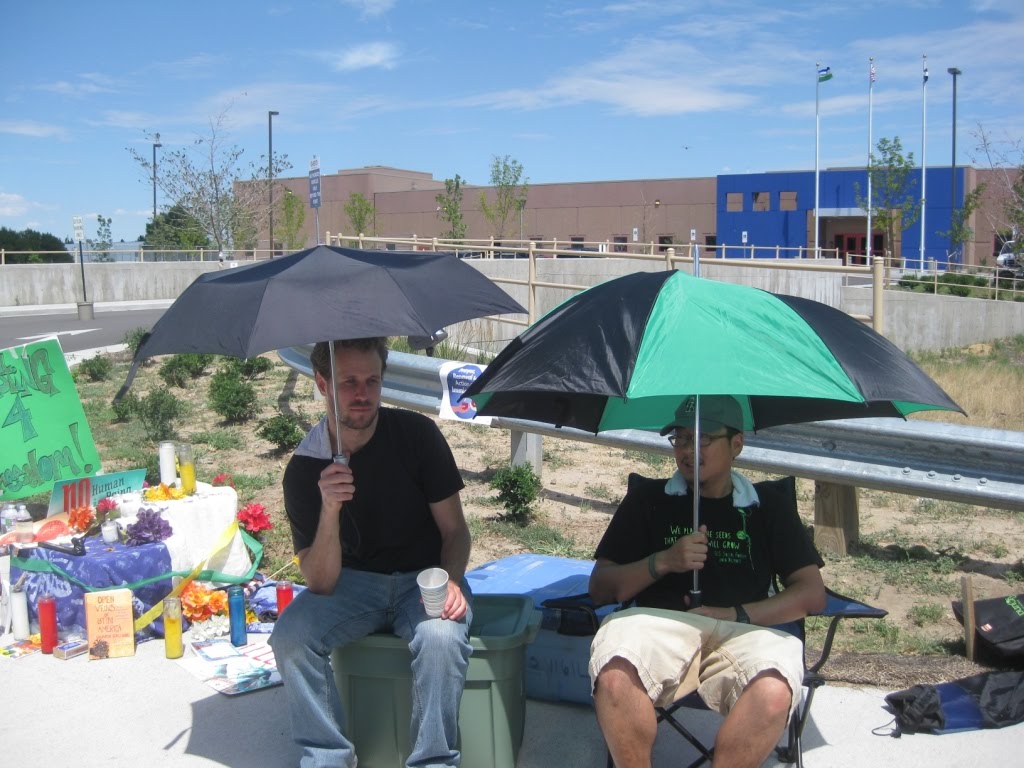

We’re here to end our time of physical vigil and fast in solidarity with those inside this detention center, knowing that we will continue to hold constant vigil in our hearts until no person is detained here.
May we have the perseverance to continue to strive for a community where no one is detained or separated from those they love, and where the humanity of all is reclaimed.
We’re here because workers – those who contribute to the creative fabric of our community, those who build the infrastructure of our society, and those who contribute their strength to making this world a more livable place for all – are imprisoned here.
May we continue to contribute our creativity, work, and strength to making this a community where everyone’s labor is valued and honored.
We’re here to honor and remember the fathers, mothers, sons, daughters, partners, neighbors, and friends detained here. We stand in resistance today of initiatives that rip our families and neighborhoods apart.
May we honor all of the relationships in our lives that sustain us, nurture us, and support us in creating a better world.
We’re here because we believe that our community can be something different and something better than this broken system of detainment has to offer us. We’re here because we vision a world where borders, barbed-wire, and fences do not control our human relationships.
May we consider the ways we perpetuate a spirit of detainment and control in our lives and strive to dismantle the spirit of enforcement everywhere in our world.
We’re here because we are thankful – for the earth’s ability to produce food for us, for the hands that sow seeds and harvest produce, for the people who transport food to our local area, and for all those whose hands have touched this bread along the way.
May we honor them in the way we share and eat this meal and remember the ways every action we do affects many others in our world.
We will now break bread together in order to break our fast as a symbol of the ways we nourish each other, the goal of sharing community together, and the desire for every member of our community to be offered a place at the same table of fellowship.
As you receive the bread, please find someone who you do not know, or don’t know very well, exchange names with them, and then offer them bread saying:
“With this bread I offer you nourishment, acceptance, and love as a member of my community.”


 Posts
Posts


